


Authenticity, Grit and Growth Beyond Setbacks
Erin McDonald: A Study in Authenticity, Grit and Growth Beyond Setbacks
This Playbook Piece was written by Izzy Daniel, a cross country and track & field athlete at Tower Hill School, graduating in 2027 and committed to the University of Chicago. An avid reader, writer, and runner, she believes body confidence comes from celebrating what your body can do.
About a year ago, I opened up my Instagram to a message from my mom. For context, my mom and I send reels and posts to each other daily—no context. However, with this message, my mom accompanied the video with the statement “You need to watch this.”
As I clicked on the post, my screen was filled with a photo of Erin McDonald, also known as @sunkisterin on Instagram. For those of you reading who are not on the “running-side” of Instagram, Erin McDonald is a 30 year old runner based in San Francisco, CA and she recently qualified for the Olympic Trials in the marathon, running a blazing 2:32.53, over 4 minutes faster than the time needed to enter. She is also ranked 250th in the world in the 10000m, running 32:59.44. For reference, that is a 5:18 mile, six times. However, the thing that makes Erin McDonald so incredible is not her speed on the track and trails, but her impact when she is not running.

Image Credit: rabbit® Chase Team (2026)
What I neglected to mention above is the fact that Erin ran for Michigan State University from 2015-2018. There she ran times that placed her among the fastest in the country from the 800m to 10000m.
But, her time as a Division I athlete was not all it was cut out to be when she was diagnosed with RED-S or Relative Energy Deficiency in Sport. RED-S is defined by the Cleveland Clinic as consuming inadequate fuel for the activity level one is engaging in on a day-to-day basis. Common symptoms include longer workout recovery time, fatigue, drop in athletic performance and irregular or missing periods (or amenorrhea). In the long term, RED-S can lead to an increased injury risk, bone density loss and a weaker immune system. Eventually, doctors may request X-Rays, Blood Tests or A Bone Density Test (or Dexa Scan) to determine the severity of the condition within a given person’s body. Treatment can include working with a dietician to figure out a fueling plan that works for a given person’s body and activity level, stopping sport or exercise for a period of time or even taking supplements to fix labs that may have become low due to inadequate nutrient consumption on a day-to-day basis. Because of RED-S and her disillusionment with the sport, Erin proceeded to leave running behind for four years after college, thinking it was something she would never return to.
In an Instagram post, Erin describes “looking at girls who were winning everything” when she was a collegiate runner. In her post she goes on to say that “I didn’t realize [some] of the athletes I was comparing myself to were running on stress, not strength”. This concept of a body maintained on adrenaline and cortisol is not one that allows for sustained athletic performance.
At the end of her post she writes: “Once I started fueling enough, everything changed. My workouts felt smoother. My injuries calmed down. My energy came back. I got stable. And eventually…faster than I had ever been…running fast shouldn’t require running yourself into the ground.” Those words hit me like a bus. As athletes, we are always told to train hard and push ourselves to our limits. However, what often goes unsaid is that pushing oneself to the absolute limit of what is possible both physically and mentally every day has a cost. It may be RED-S, a stress injury or even anxiety around sport in general.
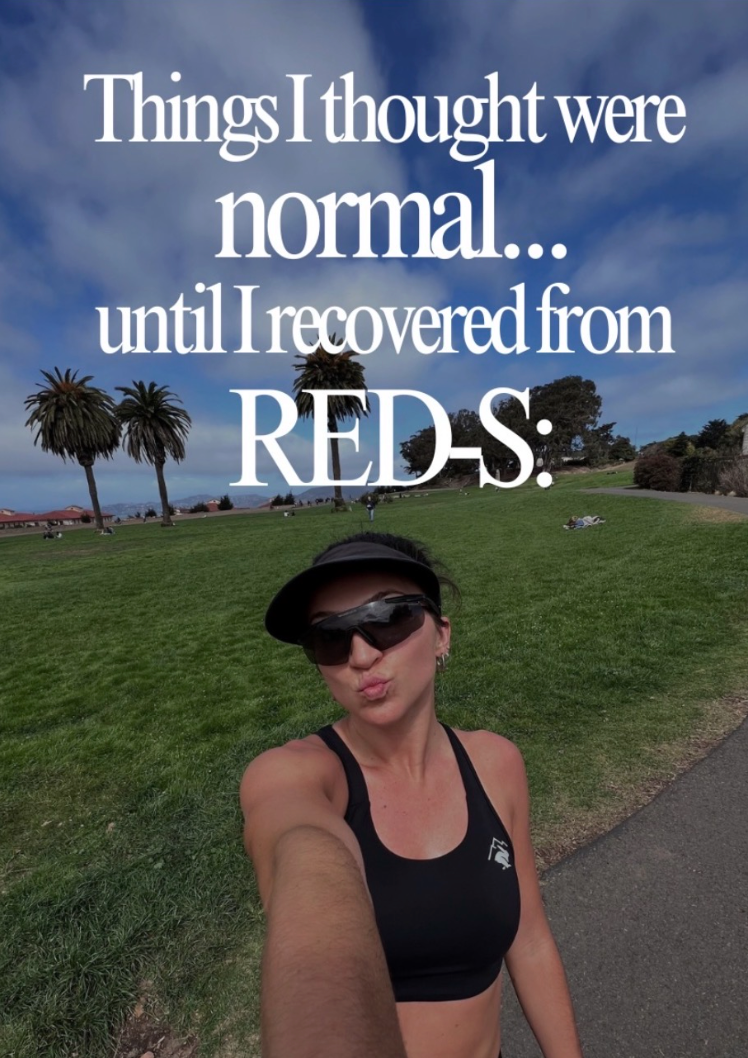
Erin shared more about her experience in a post captioned Things I Thought Were Normal…Unitl I Recovered from RED-S. In it she mentioned everything from being immobile after workouts, waking up ravenous, feeling cold all of the time, brain fog and struggling to kick at the end of a race. These are all signs of RED-S that a doctor or medical article won’t mention. Not because it is not real, but because these resources very rarely rely on real athlete experience, especially real female athlete experience. This post expanded on RED-S by bringing in personal anecdotes and clinical information. Erin mentioned that she was cold, but then also placed a note that this could be due to low iron, another nutrient marker athletes tend to be low in when they have RED-S, anemia or amenorrhea.
Perhaps the thing that was the most impactful was the fact that her post ended with an offer: her time. She included a message that her inbox, the inbox of a woman who is training for the Olympic Trials, working a full time job and managing social media, is always open. This is what athletes working together looks like and should serve as an example to both present and future athletes on the importance of community, especially when dealing with something as difficult as a RED-S diagnosis.

Image Credits: @sunkisterin
I know that for me, I began to treat running as less of a fun activity and more of a job as I entered the college recruiting process over a year ago. One bad race would send me spiraling and one off workout would mean that I had lost all of the fitness I worked so hard to build. The anxiety I felt each time I approached the start line became less of a performance enhancer and more of a mental block. That is when my mom started sending me Erin’s posts and when I began to follow her account.
The post my mom sent me a year ago now talked about Erin’s pace rigidity as she entered college: she constantly felt like she wasn’t going fast enough and this led to easy days that were up tempo and workouts that fell flat because of fatigue. This fear deeply resonated with me. I was afraid that I wouldn’t be able to continue doing the thing that I loved in college if I wasn’t going fast enough on easy runs or pushing hard enough on workout days. However, after sitting down and assessing the fact that I had lost the whole point of racing and being a runner, I began to take Erin’s words to heart.
Faster easy runs don’t mean faster races and being excited to run most days is what it is all about, or all of the joy of the sport is lost. I began to enter races with the mindset that they were a chance to show off my skill, not a moral judgement on who I am as a person. When I ran free, my ability to take risks in racing and push through the uncomfortable pain that comes with the last mile of a 5k increased. I began to remember why I loved to run: the feeling of accomplishment and the amazing people I got to surround myself with each day I went out to train and race.
 Izzy Daniel, Robyn Ambassador
Erin’s transparency is something that Instagram needs more of in general, but especially within the female runner space, where times and podiums are highlighted over the harsh realities of the sport. Some of my favorite posts she has made have been about simple things like the daily life of a runner or her take on a trend, but the best part is they are unique to her account and personality.
One of her most innovative posts was liked over 1.3k times. It was captioned Why You Will Never See Me Post “What I Eat in a Day” Content as a Semi Pro Runner. In an algorithm that frequently pushes “What I Eat in a Day” content to users, Erin’s post shows two things about her content: she is not here for likes and views and that she is unwilling to compromise her message to gain traction on a platform that rewards negativity and comparison. If you needed another reason to follow Erin, let it be that her content is made for athletes. Period. She is about her life, things she wishes she knew and what she is up to now that she has entered back into the world of running. Eyes are on her because of her performance, and, importantly, she is using her platform to say something meaningful that extends beyond a time or a place on the track.
Beyond her posts on Instagram, Erin promotes mental health for female athletes in the various podcasts she has been invited to be a guest on including the Runners of the Bay Podcast in an episode titled “Erin McDonald is Your Running Big Sister” and the Road to the Trials Podcast in an Episode titled “Rediscovering Running and a 2:32 Marathon Breakthrough”. In the former episode, she discusses her social media advocacy, her participation in the Peninsula Distance Club (her professional running team) and qualifying for the Olympic Trials after taking a break from running for four years after college. In the latter episode, she discusses her personal record performance at the 2025 California International Marathon and her collegiate career. Both of these episodes are worth a listen and they give greater insight into the intelligent and thoughtful person that comes up on my feed daily.
Looking ahead, Erin is set to run the Valencia Marathon this December. The race takes place in Valencia, Spain and is hosted annually by World Athletics. It is set to go off on Sunday, December 6th at 8:15 am. The course is flat, fast and set on a single-loop urban route. As a part of her Olympic Trials qualification, Erin is a member of the running brand rabbit® 's “Chase Team”, where she is just 1 of 11 runners supported through the brand’s resources and community. A key piece of being a member of the team is impact on and off the course, which Erin is a key proponent of on her social media. I am looking forward to watching Erin race in the lead up to the Trials, but I am perhaps most excited to send another post to my mom with a message that says: “Look! Another Erin post.”
At Robyn Athletic, we’re here to bring more stories like Erin’s to life and support female athletes at every stage of their journey. Join our Body Confident Sport movement and help build a future where girls feel supported, confident, and empowered to stay in the game. To host a workshop at your school, contact hello@robynfit.com.
Keep Reading

Robyn Ambassador and Middlebury softball player Mia Gilham shares how recovering from elbow surgery taught her to contribute to her team from the dugout. Drawing on her experience, she offers pract...
Izzy Daniel, an amazing Robyn Ambassador, explores runner Erin McDonald’s return to competitive running after experiencing Relative Energy Deficiency in Sport (RED-S), highlighting the importance o...
Let’s face it: we live in a culture that constantly pushes the narrative that women are “too much.” Too loud. Too big. Too full of ourselves. The latest trend for women is to shrink themselves as...
Robyn Voices: Marguerite Smith Marguerite Smith is a semi-professional beach volleyball player and IP Analyst at Cleary Gottlieb, where she combines her passion for innovation with a background i...

Navigating the Transition from College Athlete to Post-Grad Life The final buzzer sounds, senior night ends, and suddenly you're facing a reality you've been dreading: life without your sport. Fo...


